In Europe's rapidly evolving urban logistics landscape, safety and stability have become as critical as efficiency and range. Whether it's navigating the slick cobblestones of Amsterdam, icy streets of Copenhagen, or the steep lanes of Lisbon, delivery riders face real-world challenges that go far beyond laboratory testing. For e-cargo bike fleets, ensuring consistent traction and control — regardless of weather or terrain — is essential for maintaining operational reliability, reducing accidents, and meeting delivery schedules.
The Real Challenge: Stability Under Load
E-cargo bikes are designed to carry significant payloads, often up to 400 kg or more. Heavy loads shift the center of gravity and amplify torque forces on the wheels. When combined with wet, icy, or uneven surfaces, this increases the risk of slipping, tip-over incidents, or delayed starts.
According to the German Road Safety Council (DVR), braking distance on wet surfaces can increase by 30–40%, and low-speed cornering or uphill starts are particularly prone to slippage. Urban logistics companies in cities like Stuttgart and Zurich report that a majority of minor incidents involve heavy cargo bikes losing traction under challenging conditions.
To address these risks, manufacturers are now incorporating advanced anti-slip and hill-assist technologies, often adapted from automotive systems, into urban cargo bikes.
How Anti-Slip Systems Improve Control
Anti-slip systems enhance traction and stability by intelligently managing the interaction between tires and road surfaces. Key design and technical considerations include:
Optimized tire compounds and tread patterns: Improve grip on wet or icy roads and channel water or slush away from the contact patch.
Torque modulation via motor control: Prevents wheel spin during acceleration, ensuring stable starts even under full load.
Low center-of-gravity chassis design: Enhances lateral stability and reduces the risk of tipping when cornering or turning with heavy cargo.
Operational impact: smoother handling, shorter stopping distances, and reduced rider fatigue — all crucial for maintaining efficiency during long, multi-stop delivery shifts.
Hill-Assist: Confidence on Every Incline
Urban riders frequently face uphill starts, especially in cities with variable terrain. Hill-start assist systems hold the bike momentarily after braking, preventing backward roll while the rider engages acceleration.
Practical benefits include:
Safer maneuvering with full payloads.
Reduced stress on mechanical components from sudden torque spikes.
Predictable uphill performance, which is critical for route planning in cities like Lisbon, Oslo, or Lausanne.
Case Study: Safety and Efficiency in Numbers
Condition | Without Assist System | With Anti-Slip & Hill-Assist |
Wet road braking distance | +30–40% longer | +10% of dry condition |
Average uphill start delay | 3–5 sec | <1 sec |
Rider fatigue after 4h route | High | Noticeably lower |
Cargo stability under full load | Variable | Consistently stable |
Pilot fleets in Berlin and Amsterdam have reported similar improvements, confirming that traction and hill-assist systems reduce incidents and improve productivity under real-world urban conditions.
Designing for Real-World Urban Logistics
Today's operators no longer view these systems as“luxury add-ons.”They are operational essentials, enhancing safety, reliability, and efficiency.
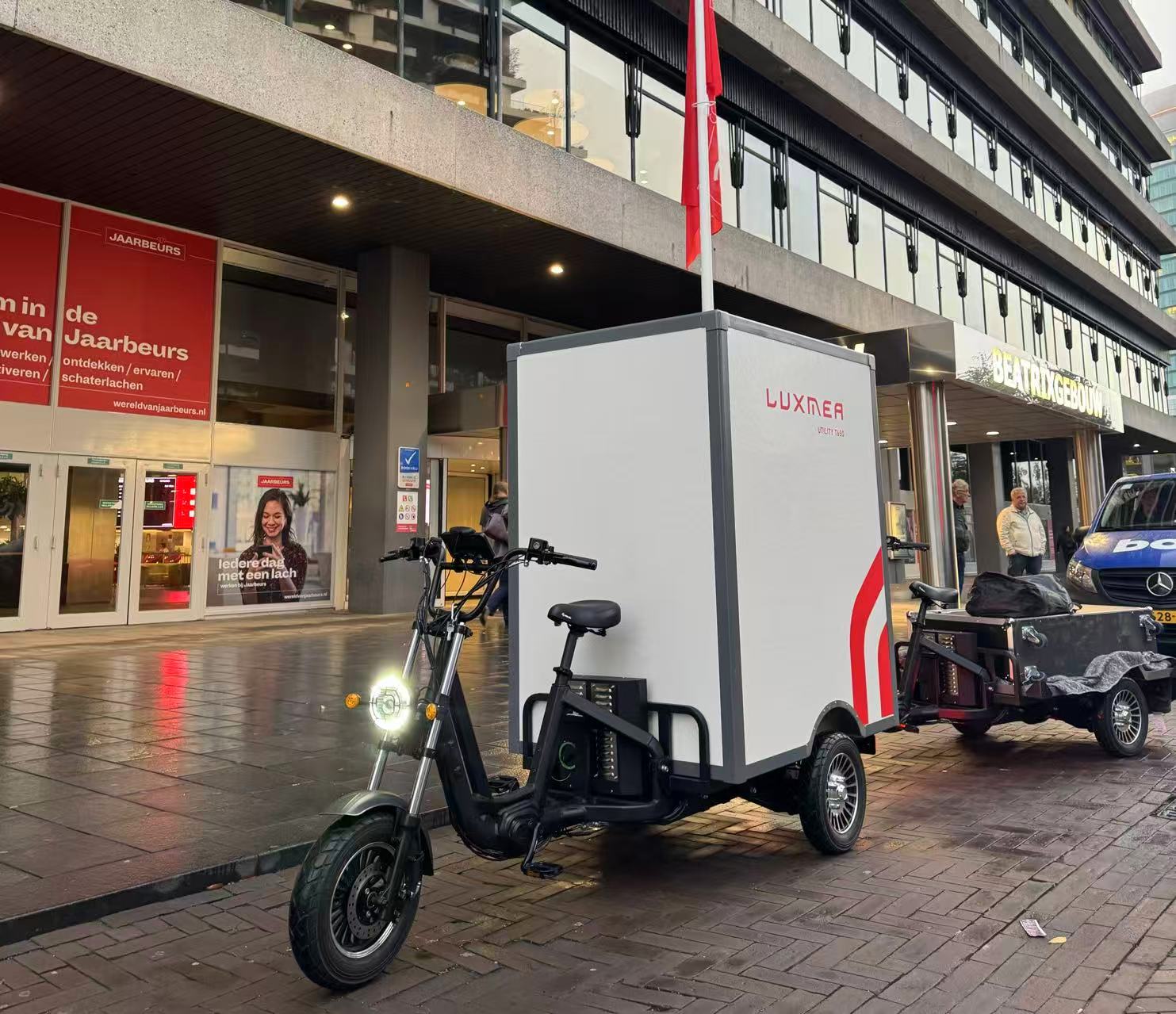
At LUXMEA, these principles are embedded into the T650 platform, which combines:
A 400 kg load capacity,
Anti-slip hill-start control,
Low center of gravity chassis,
ensuring predictable, stable handling on wet, uneven, or hilly terrain.
By integrating safety into the core design, LUXMEA enables fleets to maintain consistent performance even in adverse conditions, reducing delivery delays and mechanical wear.
Integrating Technology and Data for Smarter Logistics
Beyond mechanical systems, modern e-cargo bikes are increasingly adopting digital monitoring:
Sensors track wheel slip, acceleration patterns, and load distribution.
Data analytics provide insights for predictive maintenance, fleet performance optimization, and route planning to avoid steep or slippery segments.
Combined with AI-assisted fleet management, operators can plan deliveries that minimize risk and maximize uptime — even in challenging weather.
This integration of hardware, software, and operational intelligence represents the next frontier of urban logistics safety.
Looking Ahead: The Future of Safe Urban Cargo Delivery
As Europe's e-cargo fleets expand, safety technology will become a key differentiator:
Active traction monitoring will dynamically adjust torque in real-time.
Adaptive braking and torque control will respond to load shifts and surface changes.
Predictive route optimization will allow riders to avoid hazardous inclines or slick surfaces entirely.
Fleet operators who adopt these technologies will gain measurable improvements in uptime, rider confidence, and operational efficiency, while cities benefit from safer, quieter, and cleaner streets.
Conclusion
In the transition to zero-emission urban logistics, control and stability are as critical as range and speed.
Anti-slip and hill-assist systems are no longer optional — they are essential enablers of safe, reliable, and efficient last-mile delivery.
By combining mechanical design, digital monitoring, and operational intelligence, platforms like LUXMEA T650 turn uncertainty into confidence, ensuring every delivery is executed safely, efficiently, and sustainably — no matter the weather, load, or terrain.
FAQ:
1. Why are anti-slip systems critical for cargo bikes?
A: Because heavy loads and changing weather increase the risk of skidding, anti-slip systems maintain grip and balance, improving both safety and delivery precision.
2. Can hill-start assist help reduce maintenance costs?
A: Yes. By preventing backward roll and strain on the drivetrain, it minimizes wear on components and extends the lifespan of the vehicle.


