Introduction: The Structural Deadlock of Urban Logistics
In the urban landscapes of Paris, Berlin, and London, the traditional last-mile delivery model has reached a physical and regulatory limit. For decades, the 3.5-ton diesel van was the undisputed backbone of logistics. However, as e-commerce volumes surge, these vehicles have become a primary source of "urban friction."
Narrow medieval streets and dense 19th-century districts are not designed for the modern logistics load. Congestion is no longer a temporary inconvenience; it is a structural failure that erodes the Operational Reliability of fleet managers. In this context, electric cargo bikes are emerging not as a "green alternative," but as a mission-critical logistics asset capable of decoupling urban economic growth from traffic paralysis.
1. The Breakdown of the Conventional "Van-Centric" Model
The failure of traditional delivery models is driven by two converging forces: Policy Constraints and Geometric Reality.
Across Europe, the implementation of Low Emission Zones (LEZ) and Zero-Emission Zones is effectively "legislating away" internal combustion engines from city centers. Simultaneously, the sheer geometry of a van is its greatest liability. Studies indicate that a typical delivery van in a dense area spends up to 30-40% of its operational time searching for legal parking or idling in traffic. This "dead time" represents a massive drain on TCO (Total Cost of Ownership). When a van blocks a lane to unload, it doesn't just cause traffic; it triggers a cascade of delays that penalize the entire logistics ecosystem.
2. The Efficiency Multiplier: Data-Backed Performance
The argument for cargo bikes has shifted from environmental "feel-good" narratives to hard Logistics KPI metrics.
Recent pilot programs by global integrators like DHL and UPS have demonstrated that in high-density "Zone 1" environments, cargo bikes can achieve 60% higher drop-rates per hour compared to vans. This is achieved through "permeability"—the ability to utilize cycling infrastructure, bypass arterial congestion, and park directly at the recipient's doorstep.
Furthermore, the integration of Micro-hubs—repurposed parking garages or shipping containers serving as localized sorting centers—allows cargo bikes to operate in high-frequency loops. This "Spoke-and-Hub" model reduces the stem distance (the distance from the warehouse to the first delivery), ensuring that the battery-assisted payload is always utilized for active delivery rather than long-range transit.
3. Policy as a Catalyst for Infrastructure Maturity
The rapid adoption of cargo bikes is not a market accident; it is the result of deliberate urban engineering.
Cities like Copenhagen and Utrecht have proven that when cycling infrastructure is designed for Commercial Grade use—with wider lanes and heavy-duty surfacing—the safety and speed of cargo operations increase exponentially. We are seeing a shift from "bike paths" to "dedicated micro-logistics corridors."
Moreover, municipal incentives are shifting the financial math. Beyond direct subsidies, the "hidden tax" on vans—in the form of skyrocketing parking fines and congestion charges—makes the operational shift a fiduciary necessity for logistics providers.
4. Engineering Reliability: The Shift to Industrial Standards
One reason for the "AI-style" skepticism surrounding cargo bikes is the historical perception of them as fragile consumer products. This is where the industry is undergoing its most significant transformation: The Industrialization of the Platform.
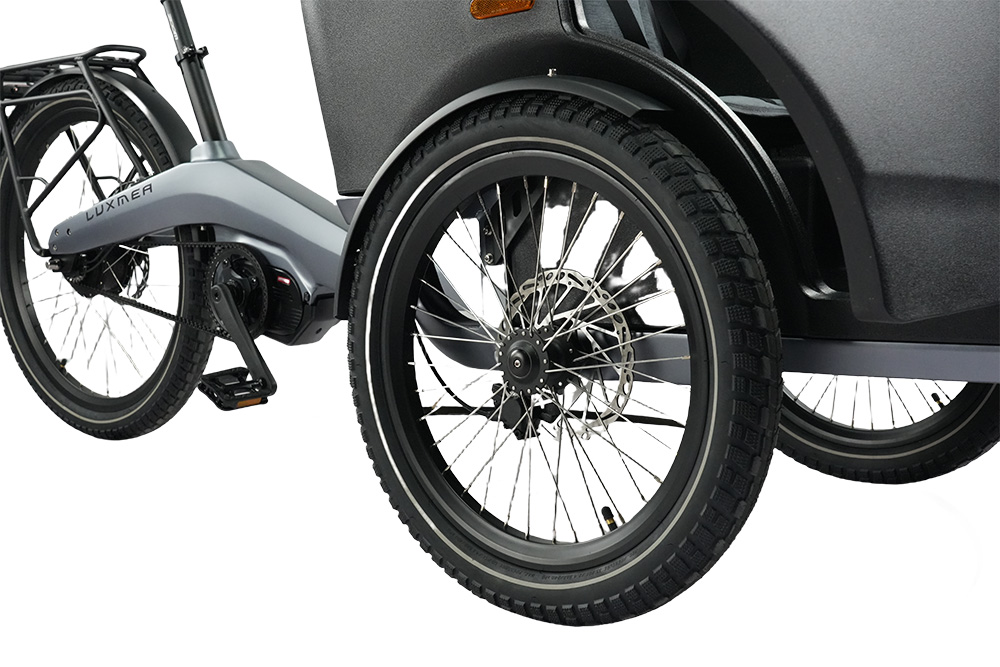
Modern commercial cargo bikes are now built to Automotive Standards. Systems such as the luxmea architecture represent this new breed of "Digital Intelligence" in hardware. They incorporate:
Heavy-Duty Powertrains: Chainless drive systems and high-torque motors designed for 300+ days of annual uptime.
Digital Access Control: Replacing physical keys with secure NFC and PIN-code systems to streamline multi-rider fleet operations.
Integrated Telematics: Utilizing CAN BUS communication to provide real-time fleet diagnostics, allowing managers to predict maintenance before a breakdown occurs.
5. Overcoming the Payload and Perception Gap
To be clear, cargo bikes are not a universal replacement for all freight. They are a specialized tool for the Final Mile.
The challenges of payload volume and weather resilience remain, but they are being addressed through modularity. Interchangeable cargo boxes allow for "Swappable Bodies," where a pre-loaded box is dropped onto a chassis, minimizing turnaround time at the hub. For temperature-sensitive goods, active cooling systems powered by the vehicle's primary battery are now enabling Cold Chain micro-logistics—a high-margin sector previously exclusive to refrigerated vans.
Conclusion: From Trend to Infrastructure
We are witnessing a structural change in the anatomy of the city. The electric cargo bike has matured into a sophisticated, software-defined vehicle that solves the fundamental paradox of urban delivery: the need for more goods moved with less space.
For OEMs, logistics operators, and technology partners, the transition is no longer optional. Those who integrate Automotive-grade reliability with Digital Ecosystems today will define the competitive landscape of the 21st-century city. The era of the "logistics van" is not over, but its dominance in the urban core is being replaced by a more agile, intelligent, and sustainable successor.
FAQ
1: Can cargo bikes fully replace delivery vans? A: Not entirely. They are best suited for last-mile deliveries in dense urban areas but typically complement rather than replace vans.
2: Are cargo bikes cost-effective for businesses? A: Yes. Lower operating costs and improved efficiency in city environments often result in better long-term ROI.
In the future, we will continue to uphold the brand concept of "high-end quality、green travel and enjoy life", continue to innovate and forge ahead, and provide the global with higher quality cargo bike products and services.