Why European Cities Are Quietly Redesigning Mobility Around People, Not Vehicles
For decades, urban life in Europe was built around car ownership.
Not because people enjoyed driving—but because cities made it necessary.
That assumption is now breaking down.
Across Europe, from mid-sized cities to major capitals, daily life is becoming increasingly possible without relying on a private car. This shift is not driven by ideology alone, but by structural changes in how cities are designed and how people move within them.
The question is no longer "Can we live without cars?"
It is "In which parts of daily life are cars no longer the best tool?"
Below are five high-frequency urban scenarios that show how car-free living is no longer a compromise—but often a more efficient choice.
1. Commuting Without Stress, Not Just Without a Car
Traditional commuting has never been exhausting because of distance alone.
It is exhausting because of uncertainty:
In compact European cities, electric assist bicycles have emerged as a highly reliable commuting tool. Not because they are fast, but because they are predictable.
Urban riders value:
Stable travel times
Flexible routing
Door-to-door convenience
Commuting becomes a transition, not a daily endurance test. When arrival time is predictable, mental load drops—and that is often more valuable than saving a few minutes.
2. Grocery Shopping Without Planning Your Day Around It
Car-based shopping tends to force a specific behaviour:
infrequent, large-scale purchases that require storage, planning, and time.
As mixed-use neighbourhoods expand across Europe, daily shopping has become more local and frequent. This shift favours mobility solutions that support small but regular loads.
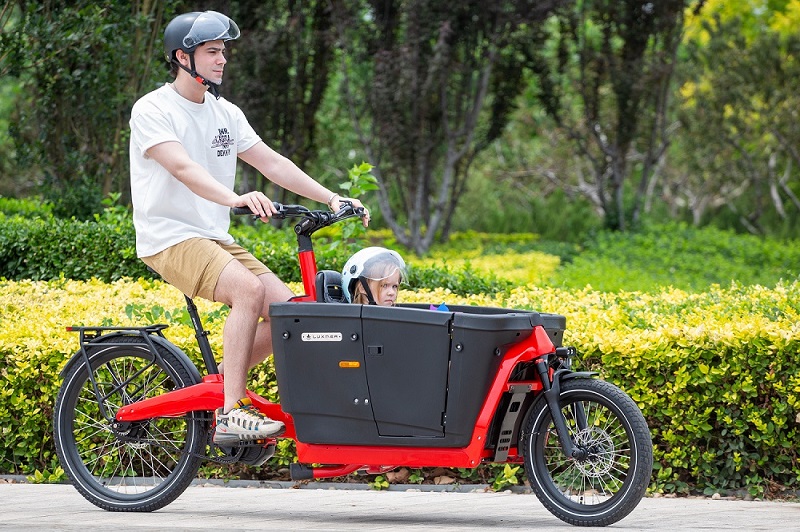
Electric cargo bikes and front-load bicycles allow urban residents to:
Shop every few days instead of once a week
Carry groceries without physical strain
Avoid parking, queues, and detours
Shopping becomes part of the day, not a logistical operation.
3. School Runs Without the Anxiety of Driving
For many families, school and childcare logistics are the strongest argument for car ownership. Yet most school trips share common traits:
Short distances
Fixed routes
High frequency
These conditions are ideal for well-designed family and cargo bicycles.
Low-speed stability, protected seating, and balanced load distribution allow parents to move confidently through traffic while maintaining full control. More importantly, children experience the city as a living environment—not something observed through a windscreen.
In many European cities, school routes are increasingly designed around cycling—not driving.
4. Work-Related Trips Without Parking Dependency
For service professionals, small business owners, and urban logistics operators, the real time loss often occurs after arrival:
Electric cargo bikes offer a different logic:
Direct access to pedestrian zones
Fast stop-and-go operation
Lower regulatory friction
In dense urban environments, not driving can actually improve operational efficiency. The city becomes easier to navigate when movement is scaled to human infrastructure.
5. Leisure and Social Life Without a Transport Barrier
Cities thrive on spontaneous movement.
Yet cars often discourage it:
When mobility is light, people move more freely.
Cycling—especially with electric assist—encourages:
The city becomes a shared social space again, not a series of destinations connected by traffic corridors.
Living Without a Car Is Not About Giving Something Up
The shift away from car dependency in European cities is not driven by sacrifice.
It is driven by alignment.
Alignment between:
Urban scale and mobility tools
Daily human energy and travel demands
Infrastructure and lived experience
Electric assist bicycles and cargo bikes succeed not because they replace cars, but because they fit the modern city better.
Car-free living is no longer about doing less.
It is about moving in ways that support everyday life—quietly, reliably, and sustainably.
FAQ
1: Is it really possible to live comfortably in a European city without a car?
A: Yes. In many European cities, compact urban design, mixed-use neighbourhoods, and reliable cycling infrastructure make daily activities—such as commuting, shopping, and school runs—efficient and comfortable without a private car.
2: Why are electric assist and cargo bikes so effective for urban life?
A: They offer predictable travel times, low operating costs, and the ability to carry people or goods without physical strain, making them well suited to short, frequent trips in dense urban environments.


