In Part 1, we examined the hidden cost gap between consumer e-bikes and commercial cargo bikes. While specifications may look comparable on paper, real-world fleet operations reveal a very different reality.
The central question was simple but critical:
Why do vehicles with similar components behave so differently once deployed at scale?
The answer is not found in batteries, motors, or displays.
It lies in system architecture—the invisible structure that governs how a vehicle behaves under stress, failure, and continuous use.
At fleet scale, risk does not disappear.
It compounds.
And architecture determines whether that risk stays local—or quietly spreads across the entire operation.
Fleet Risk Is Systemic, Not Accidental
Most fleet failures are not caused by dramatic breakdowns.
They appear quietly:
By the time these symptoms become visible, the issue is no longer technical.
It is operational—and financial.
Consumer-grade designs optimize components individually. Motors meet power targets. Batteries meet capacity specs. Controllers pass functional tests.
But fleets do not operate components.
They operate systems.
When systems are not designed as a coherent whole, small issues interact in unpredictable ways:
A software update interferes with a safety-related function
A new peripheral overloads a shared communication bus
A UI fault triggers unnecessary system shutdowns
Each component may meet its specification.
The system does not.
Response Time: The 10-Millisecond Line Between Control and Chaos
In consumer riding, a system freeze is inconvenient.
The rider stops, resets the bike, and continues.
In commercial delivery, the same event triggers a chain reaction:
Most consumer e-bikes rely on shared or single-thread communication architectures. Displays, connectivity modules, smart locks, and control systems all compete for the same resources.
Commercial cargo platforms follow a different logic, often inspired by automotive engineering principles.
Through architectural separation, safety-critical systems are isolated from non-critical ones. A common implementation is a dual CAN bus structure:
Power CAN for drive, braking, and energy management
Intelligent CAN for UI, telematics, connectivity, and peripherals
This separation ensures that even if navigation software, Bluetooth connectivity, or a smart lock crashes, the powertrain remains operational.
Fault detection and response remain within 10-millisecond cycles.
This difference never appears on a specification sheet.
But in fleet operations, it directly determines uptime.
Predictable Failure Is a Form of Safety
Fleet risk is not only about accidents.
It is about unpredictability.
Consumer systems tend to fail abruptly or ambiguously. When something goes wrong, the vehicle may simply stop working—without a clear explanation.
Commercial architectures are designed around failure behavior. Rather than attempting to eliminate failures entirely, they define how failures occur:
Systems degrade gracefully instead of shutting down
Fault states are explicit and readable
Vehicles enter controlled operating modes rather than emergency stops
In commercial fleets, predictability is safety—because it allows teams to act before problems escalate.
Software Transparency vs the Black-Box Trap
Fleet managers are not afraid of failures.
They are afraid of not knowing what failed.
Consumer e-bikes are typically closed systems. When electrical or software issues occur, diagnosis depends on physical inspection and technician experience. Vehicles remain offline not because repairs are complex—but because information is missing.
Commercial platforms reverse this dynamic through software transparency.
Architectures aligned with standardized frameworks—such as AUTOSAR principles and UDS diagnostics—make faults visible, structured, and remotely accessible.
Via a central telematics unit, fleet teams can:
Read fault codes remotely
Identify root causes before dispatching technicians
Prioritize issues based on operational impact
Without diagnostic ownership, a vehicle is not a managed asset.
It is an operational blind spot.
Security Logic: From Anti-Theft to Cargo Authority
Consumer vehicles are designed to protect the bike.
Commercial fleets must protect cargo, accountability, and trust.
Mechanical locks and consumer Bluetooth solutions degrade quickly under high-frequency delivery use. They are difficult to manage at scale and create security gaps when personnel changes.
Commercial cargo platforms integrate system-level access control, often through NFC-enabled cargo locks managed centrally.
These are not accessories.
They are permission layers.
Access rights can be granted or revoked instantly. Events are logged. Physical keys—and their associated risks—are eliminated.
This closes the control loop between vehicle, cargo, and responsibility.
Architecture Is the Only Layer That Truly Scales
At small scale, workarounds are manageable.
At fleet scale, they are fatal.
A one-hour diagnostic delay across ten vehicles is inconvenient.
Across five hundred vehicles, it becomes a crisis.
Human intervention does not scale linearly.
System architecture does—quietly, consistently, and without human intervention.
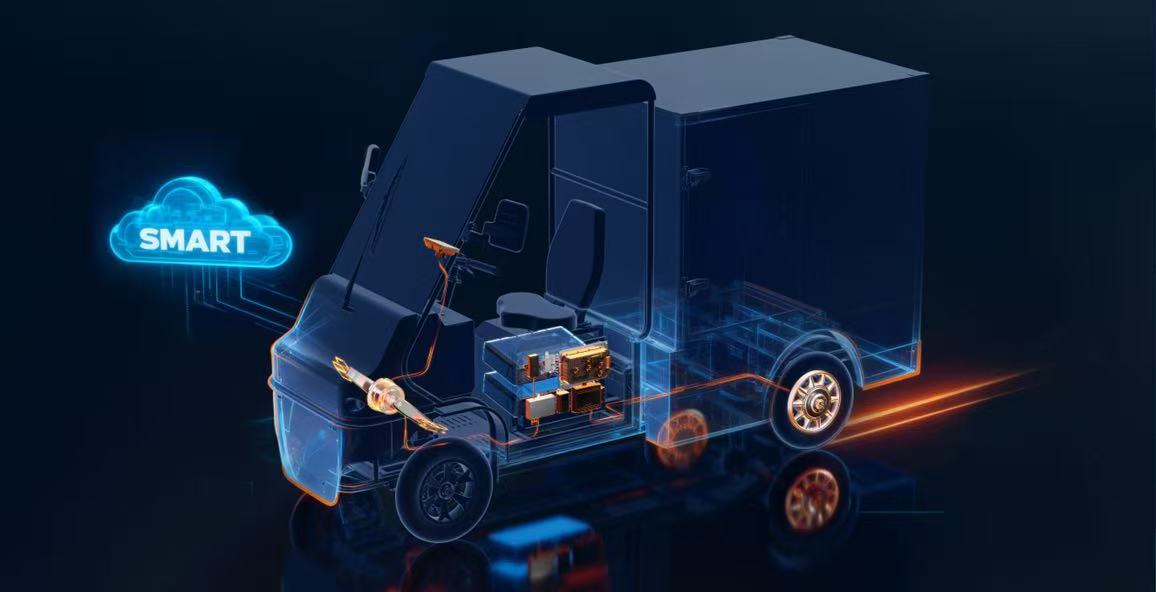
This is why experienced fleet buyers increasingly review architecture diagrams, not just specification tables.
Conclusion: TCO Is Decided Below the Surface
Consumer e-bikes optimize for purchase appeal and flexibility.
Commercial cargo platforms optimize for predictable system behavior.
Over multi-year operations, the difference appears in:
Uptime stability
Cost predictability
Operational confidence
Consumer e-bikes can move goods.
Commercial platforms sustain businesses.
And that distinction is decided long before the first delivery—at the system level.


